

MATHS TUITION · LEICESTER & ONLINE
Maths Tuition:
How to Build Powerful Skills for Life
Explore maths tuition for GCSE, AS & A Level Maths, Statistics and Further Maths. Because every learner has different needs, we start with your current skills and give each lesson a clear focus. As a result, you can build on what you know through guided practice.
For Leicester-based students and learners joining online.
Browse past papers & mark schemes →FIND YOUR FOCUS
Maths tuition for
your next step.
Choose your subject and level so that we can discuss the right support. For example, you may want to revisit the basics or tackle a harder topic.
BUILD YOUR FOUNDATIONS
Stronger foundations.
More confidence.
For example, bring a topic or question you find hard so that we can work through it together. In addition, we support both Foundation and Higher tier, so please tell us which you study.
Ask about GCSE MathsTOPICS TO DISCUSS
- Number & ratio
- Algebra & graphs
- Geometry & measures
- Probability & data
Tell us your tier, exam board and target grade so that we can agree a useful starting point.
TAKE THE NEXT STEP
Bridge the gap.
Find your rhythm.
The step from GCSE to AS brings new ideas, so we connect them to topics you already know. After that, practise each step and explain your working.
Ask about AS MathsTOPICS TO DISCUSS
- Algebra & functions
- Trigonometry
- Calculus foundations
- Statistics & mechanics
If you already study AS, bring a recent question or topic list so that we can focus our first chat.
GO FURTHER WITH UNDERSTANDING
Connect the ideas.
Tackle the questions.
For example, build your skills in pure mathematics by choosing a method and setting out your working. As a result, you can try new questions and apply the same ideas in a different way.
Ask about A Level MathsTOPICS TO DISCUSS
- Pure mathematics
- Differentiation & integration
- Statistics
- Mechanics
We discuss your exam board, topics and exam dates before planning your maths tuition. As a result, the plan can focus on your course and goals.
MAKE SENSE OF DATA
Beyond the numbers.
Understand the story.
Make sense of data, probability and results through guided practice. For example, ask about statistics within your Maths course or discuss a separate Statistics qualification.
Ask about StatisticsTOPICS TO DISCUSS
- Interpreting data
- Probability
- Distributions
- Hypothesis testing
Therefore, please share your course and exam board so that we can match the level and topics to your needs.
FOR THE NEXT CHALLENGE
Think deeper.
Explore further.
However, harder ideas need time, so bring the Further Maths topics you want to explore. For example, we can break a problem into steps and discuss why each method works.
Ask about Further MathsTOPICS TO DISCUSS
- Complex numbers
- Matrices
- Proof & advanced algebra
- Further pure & applied topics
Further Maths options vary by exam board. So, tell us your level, board and chosen modules.
TWO WAYS TO LEARN
Maths tuition in Leicester.
Or from home.
Whether you study in person or online, we start with the same question: what would help you move forward?
Meet us in person.
If you live in Leicester or nearby, you can ask about maths tuition in person.
11–15 Guildhall Lane
Leicester LE1 5FQ
Before you visit, please book your tuition appointment.
Join from wherever you are.
Join live maths tuition from home so that you can learn without the journey. For example, ask questions and work through ideas with your tutor during a lesson. Finally, practise what you have learned.
Bring your questions.
Build your understanding.
Before lessons begin, we will confirm the platform, times and what you need.
A PLAN, NOT A GUESS
How maths tuition works.
Step by step.
Therefore, maths tuition starts with your current level and goals. Before planning lessons, we discuss a short skills check so that we can find what to work on.
- 01
Tell us about you.
Share your course, exam board, topics and goals so that we can understand your needs. Parents and carers can also join the chat.
- 02
Find the starting point.
Next, discuss a short skills check before choosing your lesson focus. For example, we can review GCSE topics before you start AS or A Level.
- 03
Learn. Practise. Review.
Finally, work through examples and guided questions, then use feedback to plan your next step. For example, revisit a method before trying a new question.
A TYPICAL LESSON
Recap → Explore an idea → Solve together → Practise independently → Review
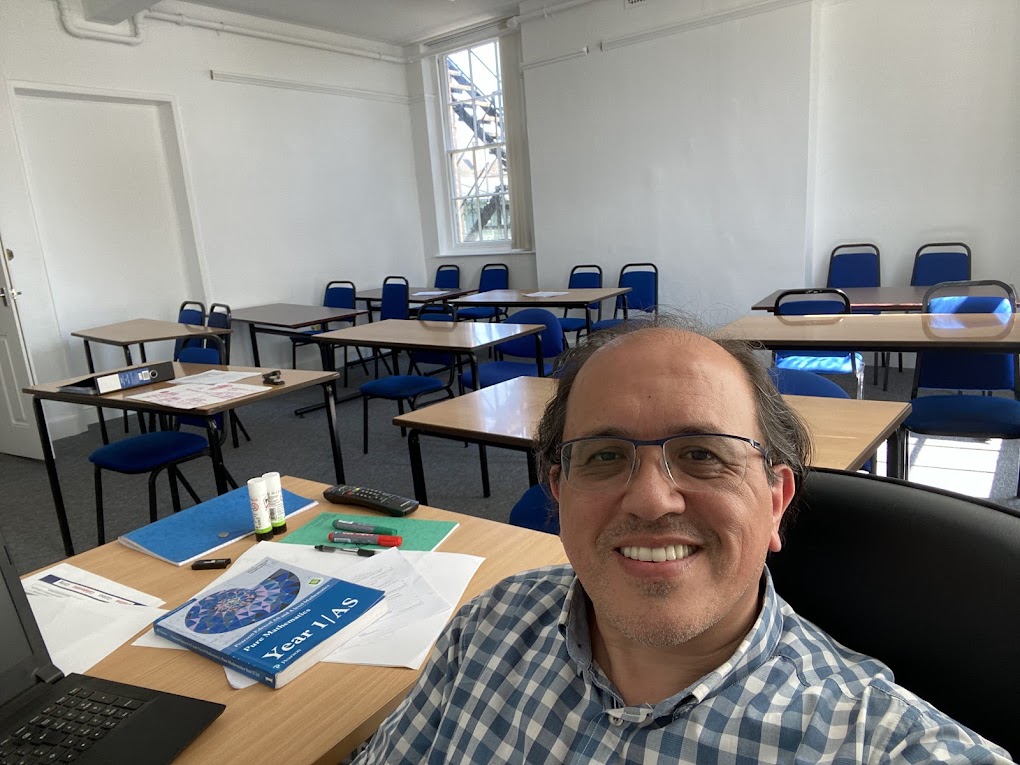
A PERSON TO ASK. SPACE TO THINK.
Personal maths tuition.
Space to ask questions.
Assoc Prof Gokhan Koyunlu
For example, bring a question, topic or exam goal so that we can discuss where you need help. Together, we will choose a starting point that suits you.
You can also ask about one-to-one or group maths tuition in Leicester or online. Before you book, we will check times and agree the lesson arrangements.
Talk about maths tuitionTHE EDEXCEL REVISION LIBRARY
Find a paper.
See how to improve.
First of all, choose your course and year before opening an official paper. Then, try the questions and use the mark scheme to check your work. For example, note where you lost marks so that you know what to practise next.
2023–2025 · 117 paper & mark-scheme pairsAlso, files open on Pearson’s official website. “Mark scheme” means the official answers and marking guidance.
About access to recent papers ↗117 paper pairs · 2023–2025
No papers match these filters.
For example, try another course, year or paper area.
2026 PAPERS
Recent papers have restricted access.
However, 2026 question papers and mark schemes are not included in this public library. This is because Pearson restricts recent exam materials to teachers and exams officers at registered centres. Instead, choose 2025, 2024 or 2023 for the public revision collection.
Check Pearson’s official availability ↗A Level MathsJune 20254 papers
Paper 1 Pure Mathematics 1
Paper 2 Pure Mathematics 2
Paper 3, Statistics
Paper 3, Mechanics
A Level MathsJune 20244 papers
Paper 1 Pure Mathematics 1
Paper 2 Pure Mathematics 2
Paper 3, Statistics
Paper 3, Mechanics
A Level MathsJune 20234 papers
Paper 1 Pure Mathematics 1
Paper 2 Pure Mathematics 2
Paper 3, Statistics
Paper 3, Mechanics
AS MathsJune 20253 papers
Paper 1 Pure Mathematics
Paper 2, Statistics
Paper 2, Mechanics
AS MathsJune 20243 papers
Paper 1 Pure Mathematics
Paper 2, Statistics
Paper 2, Mechanics
AS MathsJune 20233 papers
Paper 1 Pure Mathematics
Paper 2, Statistics
Paper 2, Mechanics
A Level Further MathsJune 202510 papers
Paper 1 Core Pure Mathematics 1
Paper 2 Core Pure Mathematics 2
Paper 3A Further Pure Mathematics 1
Paper 3B Further Statistics 1
Paper 3C Further Mechanics 1
Paper 3D Decision Mathematics 1
Paper 4A Further Pure Mathematics 2
Paper 4B Further Statistics 2
Paper 4C Further Mechanics 2
Paper 4D Decision Mathematics 2
A Level Further MathsJune 202410 papers
Paper 1 Core Pure Mathematics 1
Paper 2 Core Pure Mathematics 2
Paper 3A Further Pure Mathematics 1
Paper 3B Further Statistics 1
Paper 3C Further Mechanics 1
Paper 3D Decision Mathematics 1
Paper 4A Further Pure Mathematics 2
Paper 4B Further Statistics 2
Paper 4C Further Mechanics 2
Paper 4D Decision Mathematics 2
A Level Further MathsJune 202310 papers
Paper 1 Core Pure Mathematics 1
Paper 2 Core Pure Mathematics 2
Paper 3A Further Pure Mathematics 1
Paper 3B Further Statistics 1
Paper 3C Further Mechanics 1
Paper 3D Decision Mathematics 1
Paper 4A Further Pure Mathematics 2
Paper 4B Further Statistics 2
Paper 4C Further Mechanics 2
Paper 4D Decision Mathematics 2
AS Further MathsJune 20259 papers
Paper 1 Core Pure Mathematics
Paper 21 Further Pure Mathematics 1
Paper 22 Further Pure Mathematics 2
Paper 23 Further Statistics 1
Paper 24 Further Statistics 2
Paper 25 Further Mechanics 1
Paper 26 Further Mechanics 2
Paper 27 Decision Mathematics 1
Paper 28 Decision Mathematics 2
AS Further MathsJune 20249 papers
Paper 1 Core Pure Mathematics
Paper 21 Further Pure Mathematics 1
Paper 22 Further Pure Mathematics 2
Paper 23 Further Statistics 1
Paper 24 Further Statistics 2
Paper 25 Further Mechanics 1
Paper 26 Further Mechanics 2
Paper 27 Decision Mathematics 1
Paper 28 Decision Mathematics 2
AS Further MathsJune 20239 papers
Paper 1 Core Pure Mathematics
Paper 21 Further Pure Mathematics 1
Paper 22 Further Pure Mathematics 2
Paper 23 Further Statistics 1
Paper 24 Further Statistics 2
Paper 25 Further Mechanics 1
Paper 26 Further Mechanics 2
Paper 27 Decision Mathematics 1
Paper 28 Decision Mathematics 2
A Level StatisticsJune 20253 papers
Paper 3 Statistics in Practice
Paper 2 Statistical Inference
Paper 1 Data and Probability
A Level StatisticsJune 20243 papers
Paper 3 Statistics in Practice
Paper 2 Statistical Inference
Paper 1 Data and Probability
A Level StatisticsJune 20233 papers
Paper 3 Statistics in Practice
Paper 2 Statistical Inference
Paper 1 Data and Probability
GCSE Maths · HigherJune 20253 papers
Paper 1 Non-calculator
Paper 2 Calculator
Paper 3 Calculator
GCSE Maths · HigherJune 20243 papers
Paper 1 Non-calculator
Paper 2 Calculator
Paper 3 Calculator
GCSE Maths · HigherNovember 20243 papers
Paper 1 Non-calculator
Paper 2 Calculator
Paper 3 Calculator
GCSE Maths · HigherJune 20233 papers
Paper 1 Non-calculator
Paper 2 Calculator
Paper 3 Calculator
GCSE Maths · HigherNovember 20233 papers
Paper 1 Non-calculator
Paper 2 Calculator
Paper 3 Calculator
GCSE Maths · FoundationJune 20253 papers
Paper 1 Non-calculator
Paper 2 Calculator
Paper 3 Calculator
GCSE Maths · FoundationJune 20243 papers
Paper 1 Non-calculator
Paper 2 Calculator
Paper 3 Calculator
GCSE Maths · FoundationNovember 20243 papers
Paper 1 Non-calculator
Paper 2 Calculator
Paper 3 Calculator
GCSE Maths · FoundationJune 20233 papers
Paper 1 Non-calculator
Paper 2 Calculator
Paper 3 Calculator
GCSE Maths · FoundationNovember 20233 papers
Paper 1 Non-calculator
Paper 2 Calculator
Paper 3 Calculator
Turn a past paper into a study plan
Before you begin, check the course code and choose a paper that matches your level. For example, GCSE students should check whether they need Foundation or Higher tier. Then, try the questions on your own before opening the answers.
Afterwards, compare your working with the mark scheme. However, focus on the method as well as the final answer. For example, a correct approach may earn marks even if you make an arithmetic slip.
Next, note the topics that need more practice. For example, group similar mistakes together so you can spot a pattern. As a result, your next revision session can have a clear focus.
Finally, bring a difficult question to your tutor. Together, discuss why a method works before trying it again. Then, use a fresh question to check whether the idea makes sense.
BEFORE WE BEGIN
A few good
questions.
If you are not sure what to ask, start with the questions below.
Which subjects and levels can I ask about?
For example, we offer support with GCSE, AS and A Level Maths, Statistics and Further Maths. For example, share your course, board, tier or modules so that we can check which lessons suit you.
Can I study online instead of in Leicester?
Yes. For example, you can ask about online maths tuition or lessons in Leicester. Before you book, we will agree the format, times and lesson plan.
Do I need to be confident at maths already?
No. Tell us what feels hard so that we can find your starting point. For example, you may need to rebuild the basics before trying harder questions.
Can parents or carers get in touch?
Yes. Parents and carers can also discuss a student’s goals and needs. For example, share the subject and year group, then tell us if you prefer Leicester or online lessons.
What are the fees and lesson times?
Finally, please ask for current fees and times. For example, fees depend on your level and lesson format. Before you commit, we will confirm the price and timetable.
What should I bring to the first conversation?
For example, bring your course details and a recent piece of work. You can also share a question you need help with. However, you do not need a full study plan.
LET’S FIND YOUR STARTING POINT
A question today.
A clearer next step.
Tell us your subject and level so that we can help you plan your next step. You can also choose maths tuition in Leicester or online.
KNIGHTON EDUCATION · LEICESTER
+44 7470 800774info@knightonconsultancy.co.uk11–15 Guildhall Lane
Leicester LE1 5FQ, UK
Therefore, please book before visiting.